How Specialist Pharmaceutical Importers Support NHS Medicine Shortages

Alcatia
When a medicine shortage affects the NHS, the first objective is not necessarily to find the same product somewhere else in the world.
Pharmacy and clinical teams may first need to conserve existing stock, consider alternative strengths or presentations, switch to another licensed medicine or follow specific national shortage guidance.
But there are situations where those options cannot adequately meet a patient's clinical need.
At that point, a specialist pharmaceutical importer can provide another route into the international medicines supply chain, identifying suitable products available overseas and managing the regulatory process required to bring an unlicensed medicine into the UK.
For NHS pharmacy procurement teams, this can turn a difficult question:
"Can anyone supply this medicine?"
into a much more structured sourcing exercise.
Having difficulty sourcing a medicine?
What is a specialist pharmaceutical importer?
A specialist pharmaceutical importer is an appropriately licensed organisation able to source medicines internationally and, where the regulatory conditions are met, import unlicensed medicinal products into the UK.
This is different from simply purchasing stock from an overseas wholesaler.
The MHRA regulates the importation of unlicensed medicines. Depending on where the medicine is sourced, an importer requires the appropriate Manufacturer's "Specials" Licence (MS) or Wholesale Dealer's Licence (WDA(H)) and must notify the MHRA of its intention to import the unlicensed product before importation.
These requirements mean specialist importers operate as part of a regulated supply route between international medicine markets and UK healthcare organisations.
Why are specialist importers relevant during medicine shortages?
Medicine shortages are not always global.
A licensed medicine may be unavailable in the UK because of:
- manufacturing disruption;
- increased demand;
- supply-chain problems;
- regulatory issues;
- discontinuation;
- allocation;
- delays in replenishment; or
- shortages affecting a particular strength or presentation.
At the same time, equivalent or potentially suitable medicines may still be commercially available elsewhere.
A product might, for example, be routinely marketed in Germany, France, the United States, Canada or another regulated market while the equivalent licensed UK product is unavailable.
That does not automatically mean the overseas medicine can or should be used in the NHS.
It does mean there may be another potential supply route worth investigating.
Where do specialist importers fit into the NHS shortage response?
Specialist importers are one part of a wider medicines-shortage response.
National Medicine Supply Notifications can recommend a range of actions depending on the product concerned.
These may include:
- reviewing local stock holdings;
- conserving remaining stock;
- using another licensed strength or presentation;
- switching to another clinically appropriate treatment;
- using an alternative product off-label where appropriate; or
- considering an unlicensed medicine where licensed alternatives are not suitable.
Current NHS shortage guidance specifically recognises circumstances in which unlicensed imports of the same medicine can be available in sufficient quantities to help meet a supply gap.
The specialist importer's role is therefore not to determine which medicine a patient should receive.
It is to help establish whether an appropriate product can be sourced and supplied through the required regulatory route.
What does a specialist importer actually do?
The visible part of the process for an NHS procurement team may simply be requesting a quote.
Behind that request can sit a much broader sourcing exercise.
1. Search international medicine markets
The first challenge is finding genuine available stock.
Specialist importers can investigate manufacturers, authorised wholesalers and supply partners across multiple countries rather than relying solely on normal UK distribution channels.
The search may consider:
- active ingredient;
- strength;
- dosage form;
- manufacturer;
- source country;
- pack configuration;
- quantity;
- shelf life;
- storage requirements; and
- expected lead time.
This is important because identifying a medicine by molecule alone is rarely sufficient.
A pharmacy team needs to know which actual product is available.
2. Identify the regulatory status of the product
A medicine available overseas may be:
- licensed in the source country;
- licensed in several international markets;
- manufactured for a particular national market; but
- unlicensed for supply in the UK.
The specialist importer establishes the product being proposed and the route through which it would need to enter the UK.
An imported product that does not have the appropriate UK marketing authorisation is treated as an unlicensed medicine, even where it is a routinely authorised commercial medicine in its home market.
3. Provide product information for pharmacy assessment
Finding stock is only part of the job.
NHS pharmacy teams also need sufficient information to assess whether the proposed medicine is appropriate for local use.
NHS Specialist Pharmacy Service guidance states that imported unlicensed medicines require assessment of their pharmaceutical quality and suitability. Information may include details about the manufacturer, overseas Marketing Authorisation Holder, regulatory status and characteristics of the specific product being offered.
A specialist importer may therefore need to obtain information covering areas such as:
- manufacturer;
- country of authorisation;
- marketing authorisation details;
- strength;
- pharmaceutical form;
- ingredients or excipients;
- packaging;
- storage requirements;
- shelf life;
- product literature; and
- batch or quality documentation where applicable.
The NHS organisation can then undertake the appropriate local assessment.
Specialist importers do not replace local quality assurance
This distinction is particularly important.
An imported unlicensed medicine does not undergo the same central UK marketing-authorisation assessment as a licensed UK medicine.
NHS shortage notifications explicitly warn that unlicensed imports do not undergo a central quality assessment or suitability evaluation and should therefore be assessed locally in accordance with the organisation's unlicensed medicines procedures.
The specialist importer can support that process by supplying the required information.
The decision to approve and use the product remains with the appropriate healthcare professionals and NHS organisation.
4. Manage the MHRA import notification process
Where an unlicensed medicine is to be imported, the licensed importer must notify the MHRA before importation.
The notification process provides information about the proposed product and the special clinical need supporting its import.
After receiving a notification, the MHRA can:
- raise no objection;
- request further information;
- impose conditions; or
- object to the import.
The MHRA guidance provides for a notification assessment period of up to 28 days after acknowledgement, although urgent cases can be considered more quickly where justified.
A "no objection" position should not be interpreted as a UK marketing authorisation. The medicine remains unlicensed and the receiving healthcare organisation retains responsibility for its own clinical and quality assessment.
5. Coordinate international logistics
Even after a suitable source has been identified, the medicine still needs to reach the UK.
Depending on the product, that can involve:
- supplier coordination;
- international freight;
- temperature-controlled transport;
- customs processes;
- import documentation;
- warehouse receipt;
- storage;
- batch tracking; and
- onward distribution.
For products with specialist handling requirements, the logistics can be as important as locating the stock itself.
A medicine that is theoretically available overseas is not useful to an NHS Trust if it cannot reach the pharmacy within the required timeframe and under appropriate storage conditions.
6. Establish realistic lead times
During a shortage, procurement teams often need a very simple answer:
When can we actually have it?
That answer depends on more than whether stock exists.
Lead times may be affected by:
- the source country;
- manufacturer availability;
- quantity required;
- supplier dispatch times;
- regulatory notification;
- documentation;
- freight;
- customs;
- temperature-control requirements; and
- whether stock is already held by the UK importer.
National Medicine Supply Notifications regularly warn pharmacy teams that lead times for unlicensed imports can vary and that orders should be placed within appropriate timeframes.
That makes the required-by date one of the most important pieces of information in any shortage sourcing enquiry.
7. Help procurement teams understand supply continuity
Finding ten packs is different from establishing a sustainable source.
Where a shortage is expected to last several months, procurement teams may need to understand:
- how much stock is currently available;
- whether further batches can be sourced;
- typical replenishment lead times;
- how much demand exists internationally;
- whether another manufacturer is available; and
- whether the proposed source is likely to remain viable.
This becomes especially important for medicines used in long-term treatment.
A specialist importer can investigate not only the immediate requirement but also the potential for continued supply if the UK shortage persists.
Why can't an NHS Trust simply order directly from overseas?
International medicine procurement involves regulatory responsibilities that do not apply to an ordinary domestic purchase.
The MHRA requires organisations importing unlicensed medicines to hold the appropriate licence and to complete the required notification process.
Using an appropriately licensed specialist importer therefore provides a regulated route through which the overseas product can be sourced and imported.
It also gives pharmacy teams a UK counterpart responsible for coordinating the international supplier, import process and associated product information.
When might an unlicensed import be considered?
Unlicensed medicines cannot simply be used as alternative commercial products whenever the licensed version is expensive or difficult to obtain.
MHRA guidance requires a special clinical need that cannot appropriately be met by an available authorised medicinal product. Supply based purely on cost, convenience or institutional preference does not constitute a valid special clinical need.
During a genuine medicine shortage, however, the licensed product that would ordinarily meet that need may no longer be available.
National shortage guidance may then specifically identify imported unlicensed medicines as an option where licensed alternatives are not appropriate.
This is where specialist pharmaceutical importers can become particularly relevant.
How do NHS Medicine Supply Notifications use specialist importers?
Medicine Supply Notifications sometimes identify specialist importers that have confirmed they can source a particular unlicensed medicine.
This gives pharmacy procurement teams potential supply routes to investigate alongside the clinical actions contained within the shortage notification.
For example, a February 2026 Medicine Supply Notification covering shortages of co-trimoxazole oral suspension stated that unlicensed supplies could be sourced and listed specialist importers that had confirmed availability.
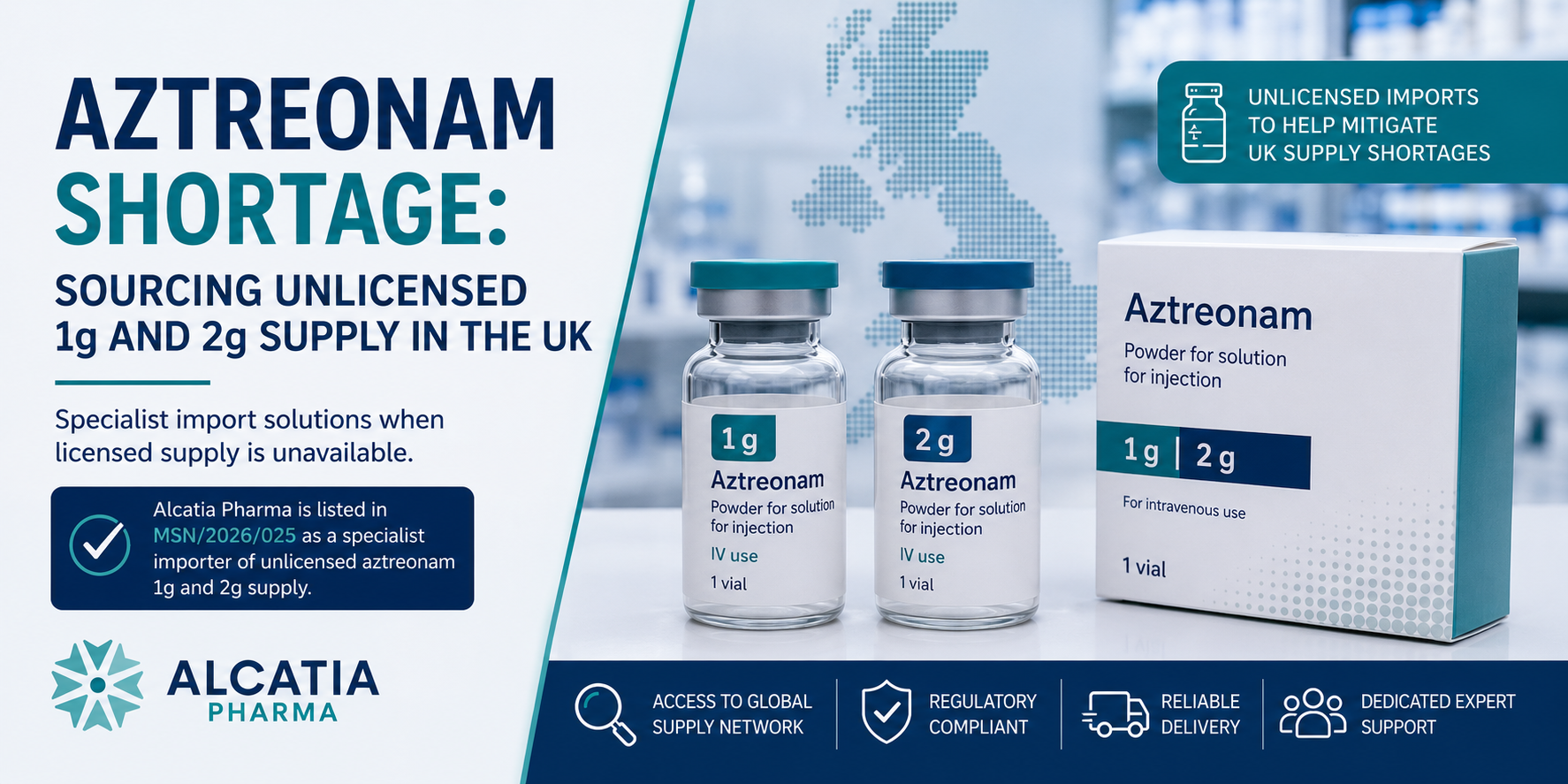
Similarly, the June 2026 notification covering shortages of aztreonam 1 g and 2 g powder for solution for injection stated that specialist importers had sourced unlicensed products and that lead times varied.
These notifications demonstrate the practical role specialist importers can play when national medicine supply becomes constrained.
Alcatia Pharma and NHS medicine shortages
Alcatia Pharma has been named in official Medicine Supply Notifications as a specialist importer that confirmed it could source products affected by UK shortages.
For example:
Co-trimoxazole oral suspension
In February 2026, Alcatia Pharma was listed among the specialist importers that had confirmed they could source unlicensed co-trimoxazole 40 mg/200 mg/5 ml and 80 mg/400 mg/5 ml oral suspension during the relevant supply disruption.
Aztreonam injection
In June 2026, Alcatia Pharma was also listed among the specialist importers that had confirmed they could source unlicensed aztreonam 1 g and 2 g powder for solution for injection vials during a Tier 2 medicine supply issue.
These examples illustrate the role Alcatia can play: investigating international availability when conventional UK supply cannot meet demand.
They should not be interpreted as meaning an unlicensed import is automatically the appropriate solution for every shortage. The clinical and governance requirements described in the relevant shortage notification still apply.
What should procurement teams send to a specialist importer?
A sourcing investigation can move much faster when the requirement is clearly defined.
At minimum, provide:
Medicine
The exact medicine or active ingredient required.
Strength
For example:
1 g
rather than simply the medicine name.
Pharmaceutical form
For example:
- tablet;
- capsule;
- oral solution;
- vial;
- ampoule;
- injection;
- powder for solution for injection;
- pre-filled syringe.
Quantity
Provide the approximate number of packs, units, vials or doses required.
Required-by date
Tell us when the stock needs to arrive.
This allows the importer to distinguish between options that technically exist and those that could realistically meet your requirement.
What other information helps?
Where possible, include:
- existing UK product;
- preferred manufacturer;
- pack size;
- minimum shelf life;
- storage requirements;
- relevant Medicine Supply Notification;
- whether alternative presentations can be considered;
- expected duration of demand; and
- any product characteristics that cannot be substituted.
You do not need to know which international market has stock.
That is what the sourcing investigation is designed to establish.
What should procurement teams ask a specialist importer?
When reviewing a potential unlicensed import, useful questions include:
- What exact product have you sourced?
- Who is the manufacturer?
- In which country is it authorised?
- Where will the product be sourced from?
- How much stock is available?
- What shelf life can be supplied?
- What is the pack size?
- What are the storage conditions?
- What language is used on the packaging?
- What product and quality documentation is available?
- What is the expected lead time?
- Is additional supply likely to remain available?
- What regulatory route applies?
This information allows procurement, quality and clinical teams to assess the proposed product rather than making decisions based solely on price and availability.
Specialist sourcing works best when procurement starts early
During a national shortage, multiple healthcare organisations can be trying to source the same medicine at the same time.
International stock can therefore change quickly.
Waiting until the final packs are being used can significantly reduce the number of workable options.
Where a medicine is known to be entering shortage, procurement teams can engage specialist importers earlier to understand:
- what international products exist;
- which markets have stock;
- indicative lead times;
- whether supporting documentation can be obtained; and
- whether continued supply could potentially be maintained.
That does not mean ordering unlicensed medicine before it is required.
It means obtaining enough supply intelligence to make better decisions if the shortage deteriorates.
Specialist importers support the procurement decision, not the clinical decision
This distinction should remain clear throughout the process.
The specialist importer can answer questions such as:
What products are available?
Where are they manufactured?
How much stock can be sourced?
How quickly could it reach the UK?
What documentation is available?
The pharmacy and clinical team determine:
Is this product appropriate for our patients?
Does the special clinical need exist?
Does it meet our quality requirements?
Should we use it?
The two functions work together, but they are not interchangeable.
Need help sourcing a medicine during a shortage?
If your usual UK supply route cannot meet a requirement, Alcatia Pharma can investigate potential sourcing options.
You do not need to know whether overseas stock exists before contacting us.
Tell us:
What medicine you need.
What strength and form you require.
How much you need.
When you need it.
Our sourcing team can investigate the available supply routes and provide the information needed for your pharmacy team to assess the options.
Having difficulty sourcing something?
This article is intended to provide general information for healthcare procurement and medicines-supply professionals. It does not constitute clinical, prescribing, legal or regulatory advice. Any decision to prescribe, procure or use an unlicensed medicine should be made by appropriately authorised professionals in accordance with current MHRA requirements, NHS guidance and applicable local governance procedures.